

Airport Construction and Maintenance: A Comprehensive Guide to Construction Materials and Technical Specifications
Airport Construction and Maintenance: A Comprehensive Guide to Construction Materials and Technical Specifications
Technical Engineering Article | Mawadna.com | November 2026
Airports are among the most important strategic infrastructure projects, playing a vital role in supporting national economies, promoting trade and tourism, and strengthening connectivity between countries and international markets.
Airport construction, expansion, and maintenance projects are characterized by engineering complexity and demanding operational requirements. Civil, structural, electrical, and mechanical works must comply with strict technical standards to ensure aircraft and passenger safety while achieving long-term sustainability and operational efficiency.
Airport construction extends far beyond runways and passenger terminals. It encompasses an integrated network of taxiways, aircraft aprons, stormwater drainage systems, airfield lighting, internal roads, security fencing, maintenance facilities, and logistics infrastructure.
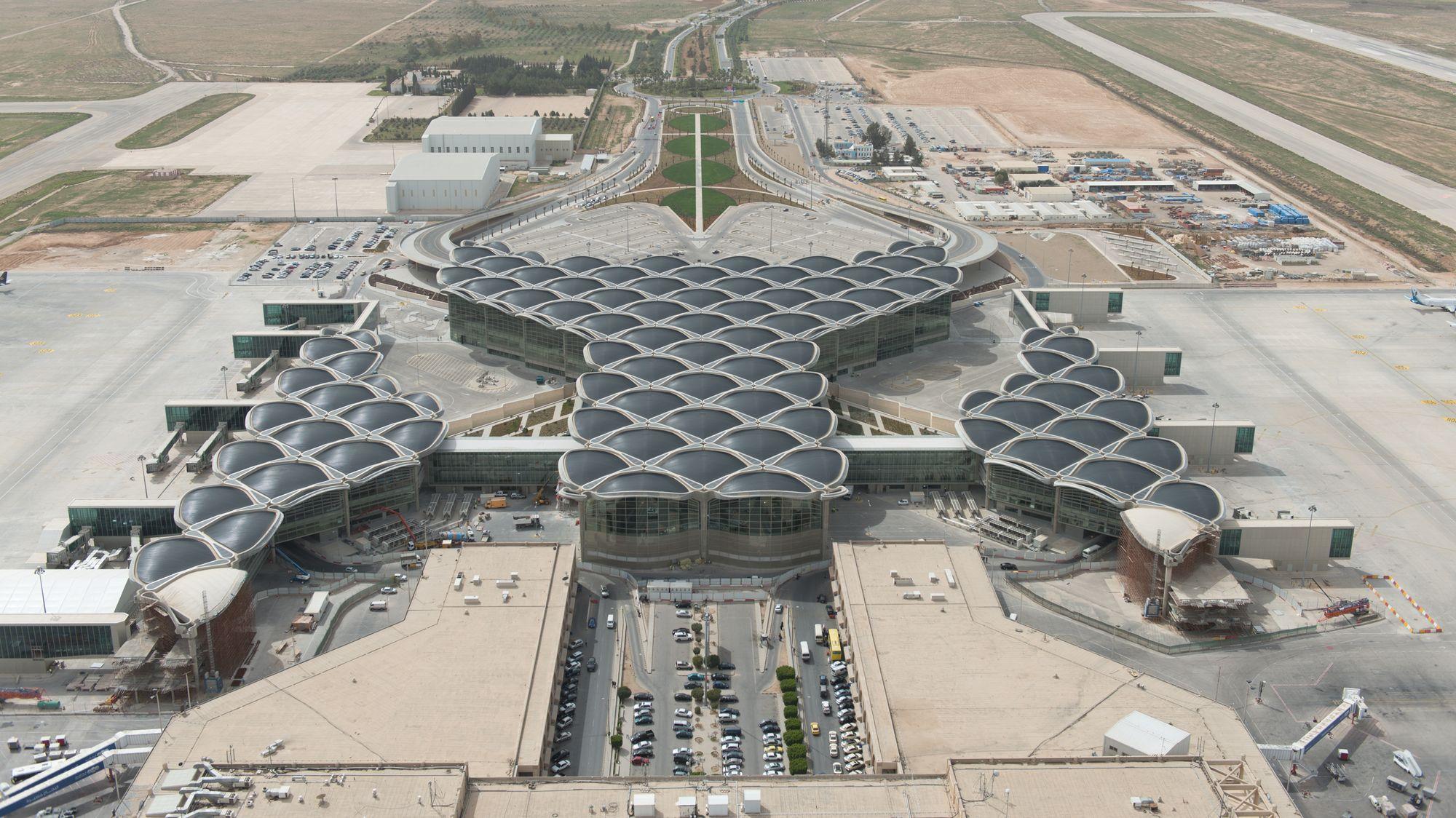
Queen Alia International Airport (QAIA) is one of Jordan's most prominent examples of modern infrastructure development, having undergone major construction, expansion, and modernization projects, alongside ongoing and planned developments, including the rehabilitation of the Southern Runway.
This article by Mawadna.com explores the main construction materials used in airport development and maintenance, their technical characteristics and applications, and the key international standards governing the aviation infrastructure sector.
1. Queen Alia International Airport – A Model for Infrastructure Development in Jordan
Located south of Amman, Queen Alia International Airport is Jordan's primary aviation gateway and one of the country's most important transportation facilities, connecting Jordan to regional and international markets.
The new passenger terminal officially opened in March 2013, followed by the completion of the second expansion phase in 2016, increasing the airport's annual passenger capacity to approximately 12 million.
Key Engineering and Architectural Features
1. Distinctive Architectural Design
Designed by Foster + Partners, the new passenger terminal reflects the surrounding natural environment and local cultural heritage.
Its roof consists of a series of repetitive concrete domes that provide shading and contribute to the building's thermal performance. Extensive glass façades allow natural daylight into the terminal.
2. Phased Expansion Capability
The airport was designed to accommodate future passenger growth through progressive expansion without requiring complete reconstruction of its primary facilities.
3. Two Parallel Runways
The airport operates two main parallel runways, designated North and South. Each runway measures approximately 3,660 meters in length and 61 meters in width, supporting aircraft takeoff and landing operations in accordance with applicable operational requirements.
4. Sustainability and Energy Efficiency
The airport has implemented several energy-efficiency initiatives, including replacing conventional runway lighting with LED technology. Other sustainability projects include solar energy systems and carbon emissions management.
5. Future Expansion and Development Projects
The development plan for 2026–2029 aims to increase the airport's passenger handling capacity from 12 million to 18 million passengers annually.
The plan also includes 15 development projects intended to improve passenger experience, operational efficiency, and airport facilities.
Airport International Group (AIG)
Airport International Group (AIG) is responsible for developing, managing, and operating Queen Alia International Airport under a Build-Operate-Transfer (BOT) concession agreement with the Jordanian government.
The partnership began in 2007, and the concession agreement was subsequently extended until 2039 to support continued infrastructure development, operational performance, and service quality.
AIG includes local and international investors, with the French company Groupe ADP holding a majority stake.
The group plays a major role in managing airport development, rehabilitation, and maintenance projects in coordination with the Ministry of Transport and relevant regulatory authorities.
2. Main Components of Airport Construction Projects
1. Runways
Runways are designated aircraft takeoff and landing surfaces. They are engineered to withstand repeated and dynamic aircraft loads while maintaining high standards of surface smoothness and skid resistance.
2. Taxiways
Taxiways connect runways to aircraft parking aprons, maintenance facilities, and cargo areas. They must withstand repeated aircraft wheel loads and operational traffic.
3. Aircraft Aprons
Aprons accommodate aircraft parking, passenger boarding, baggage handling, and refueling operations. They require durable pavements with appropriate resistance to fuel and oil exposure.
4. Terminals and Airport Facilities
These include passenger terminals, air cargo facilities, control centers, warehouses, maintenance buildings, and firefighting facilities.
5. Airport Infrastructure
Airport infrastructure includes electrical networks, water supply, drainage, fuel distribution, communications, airfield lighting, internal roads, perimeter fencing, and security facilities.
3. Construction Materials Used in Airport Projects
3.1 Earthworks and Soil Improvement
Site preparation, earthworks, and soil improvement are fundamental stages of airport construction.
Subgrade bearing capacity and compaction quality significantly influence pavement performance, structural stability, and long-term service life.
- Selected Fill Material Engineered filling and earthworks
- Granular Fill Granular backfilling and foundation layers
- Crushed Aggregates Improving pavement layer bearing capacity
- Natural Gravel Filling and drainage applications
- Geotextile Separation, filtration, and layer protection
- Geogrid Soil reinforcement and stabilization
- Cement Soil stabilization and improvement
- Lime Treatment of specific soil types
- Soil Stabilizers Improving soil properties according to design requirements
Main Required Tests: Particle size distribution, Proctor compaction test, field density test, California Bearing Ratio (CBR), and other tests specified for the project.
3.2 Runway and Taxiway Subbase and Base Courses
Subbase and base layers are constructed above the prepared natural subgrade to distribute aircraft loads and reduce pavement deformation and settlement.
Their thicknesses and material specifications depend on the structural design and pavement type.
- Granular Subbase Granular subbase layer P-154
- Aggregate Base Course Aggregate base layer P-208
- Crushed Aggregate Base Crushed aggregate base layer P-209
- Cement-Treated Aggregate Base Cement-stabilized aggregate base P-304
- Lean Concrete Base Lean concrete base layer P-306
- Cement-Treated Permeable Base Permeable cement-treated base P-307
- Recycled Concrete Aggregate Recycled concrete aggregate applications P-219
Technical requirements are determined by the approved pavement design, with reference to FAA AC 150/5370-10 specifications where applicable.
3.3 Airport Asphalt Pavement
Asphalt pavement is widely used for airport runways, taxiways, certain apron areas, and operational roads.
One of its main advantages is the ability to perform construction, rehabilitation, and resurfacing works in phases according to airport operational requirements.
Airport asphalt mixtures differ from conventional road mixtures in their design requirements, particularly regarding resistance to heavy aircraft loads, repeated deformation, and specific surface performance criteria.
Main Materials:
- Asphalt Binder.
- Crushed Aggregates.
- Mineral Filler.
- Polymer-Modified Bitumen.
- Asphalt Prime Coat.
- Asphalt Tack Coat.
- Fuel-Resistant Asphalt Mix for suitable applications.
- FAA P-401 Asphalt Mix Pavement
- FAA P-403 Asphalt Mix Pavement for Base, Leveling, or Surface Courses
- FAA P-404 Fuel-Resistant Asphalt Mix Pavement
- FAA P-602 Emulsified Asphalt Prime Coat
- FAA P-603 Emulsified Asphalt Tack Coat
Asphalt paving operations require strict quality control of mix temperature, aggregate gradation, pavement density, air voids, surface smoothness, and compaction quality.
3.4 Concrete Pavement and Aircraft Aprons
Rigid concrete pavement is used in certain airport runways, taxiways, and aircraft aprons, particularly where pavements are exposed to concentrated and repeated aircraft loads or require suitable performance under stationary aircraft and re-fueling operations.
- Portland Cement Concrete production
- Coarse & Fine Aggregates Concrete mix components
- Concrete Admixtures Improving concrete properties
- Reinforcing Steel Reinforcement where required by design
- Dowel Bars Load transfer between concrete slabs
- Tie Bars Connecting slabs at specified joints
- Joint Sealants Preventing water infiltration through joints
- Curing Compounds Concrete curing
- Preformed Joint Seals Preformed joint sealing systems
- Rapid-Setting Concrete Fast-track concrete repairs where approved
Important specifications include FAA P-501 for concrete pavement and FAA P-604 and P-605 for pavement joint sealing systems.
3.5 Airport Stormwater Drainage Systems
Drainage systems are essential for protecting runways, taxiways, and pavement foundations.
Water accumulation can accelerate pavement deterioration and reduce surface friction, potentially affecting aircraft operational safety.
- Reinforced Concrete Pipes Stormwater drainage pipelines
- HDPE / uPVC Pipes Drainage networks according to design
- Precast Manholes Inspection chambers
- Catch Basins Stormwater collection
- Trench & Slot Drains Linear drainage channels
- Geotextile Separation and filtration
- Drainage Gravel Granular drainage backfill
- Concrete Culverts Concrete drainage culverts
- Gratings & Covers Drainage and manhole covers
- Oil-Water Separators Oil separation in designated drainage areas
FAA specifications D-701, D-702, D-705, and D-751 cover various drainage materials and associated structures.
3.6 Airfield Lighting and Electrical Systems
Airports require specialized airfield ground lighting systems to guide aircraft and identify taxiways, runways, and approach, takeoff, and landing areas.
- Runway Edge Lights Runway edge identification
- Taxiway Lights Taxiway illumination and guidance
- Runway Centerline Lights Runway centerline guidance
- Threshold & End Lights Runway threshold and end identification
- Airfield LED Fixtures Specialized airfield lighting
- Airfield Electrical Cables Electrical distribution for airfield systems
- Cable Ducts & Conduits Cable routing and protection
- Isolation Transformers Isolation of lighting circuits
- Constant Current Regulators Airfield lighting current regulation
- Electrical Manholes Electrical inspection chambers
- Guidance Signs Illuminated airfield guidance signs
One notable example is Queen Alia International Airport's modernization of its North and South Runway lighting systems using LED technology.
According to the Airports Council International's 2019 report, the Southern Runway lighting upgrade achieved annual energy savings of approximately 779,000 kWh, demonstrating how modern lighting technologies can reduce energy consumption and operating costs.
3.7 Airfield Markings and Pavement Paints
Airfield pavement markings are essential for aircraft guidance, ground vehicle movement, and the identification of operational and parking areas.
Main Materials:
-
Airport Runway Marking Paints.
-
Waterborne Pavement Marking Paints.
-
Reflective Glass Beads, where required.
-
Surface Preparation Materials.
-
Marking Removal Materials.
-
Coatings resistant to wear and operational conditions, as specified.
FAA P-620 is an important technical reference for airport runway and taxiway marking works.
All markings must comply with the approved airport drawings, dimensions, and color requirements.
3.8 Airport Security Fencing and Gates
Airport facilities require secure perimeter protection systems to prevent unauthorized access and restrict the entry of animals or foreign objects into operational areas.
- Galvanized Chain-Link Fence Airport perimeter fencing
- Welded Steel Mesh Security fencing
- Structural Steel Sections Fence posts and structural supports
- Steel Sliding Gates Security and service access gates
- Reinforced Concrete Fence and gate foundations
- Protective Coatings Corrosion protection
- Barbed / Razor Wire Additional security protection
- Wildlife Exclusion Fencing Preventing animal access
3.9 Airport Terminal Building Materials
Airport terminal buildings involve a wide range of civil, structural, architectural, mechanical, and electrical construction materials.
- Concrete Works Ready-Mix Concrete, Reinforcing Steel
- Steel Structures Structural Steel, Steel Deck
- Façade Systems Curtain Wall, Aluminum, Insulated Glass
- Roofing Systems Metal Roofing, Insulation, Waterproofing
- Partitions Gypsum Board, Fiber Cement, Acoustic Panels
- Flooring Granite, Terrazzo, Porcelain, Epoxy
- Insulation Thermal, Acoustic & Fire Insulation
- HVAC Systems HVAC Ducts, Chillers, Pipes, Valves
- Electrical Systems Cables, Switchgear, Generators, UPS
- Fire Protection Sprinklers, Fire Pumps, Firestop Systems
Material selection must account for fire resistance, sustainability, acoustic and thermal insulation, durability, and high passenger traffic.
4. Southern Runway Rehabilitation Project at Queen Alia International Airport
The Southern Runway at Queen Alia International Airport is one of the airport's essential operational assets.
Designated 08R/26L, the runway measures approximately 3,660 meters in length and 61 meters in width.
On July 15, 2026, the Jordan News Agency (Petra) reported that the airport's development plans include a major Southern Runway rehabilitation project, alongside 15 development projects aimed at improving operational efficiency and airport services.
Runway rehabilitation projects are highly specialized engineering works requiring careful consideration of aircraft load-bearing capacity, surface smoothness, skid resistance, drainage performance, airfield lighting, and pavement markings.
What Works May Be Included in Runway Rehabilitation Projects?
The scope of rehabilitation depends on pavement condition assessments, engineering studies, and test results.
Typical projects may include the following activities.
1. Structural Pavement Condition Assessment
Engineering investigations and testing to evaluate pavement load-bearing capacity and identify cracks, deformation, settlement, and other deterioration indicators.
2. Removal of Damaged Pavement Layers
Asphalt milling or removal of deteriorated pavement sections to the required depths, based on the approved rehabilitation design.
3. Pavement Reconstruction
Supply, placement, and compaction of base layers, asphalt mixtures, or concrete pavement in accordance with the approved design, including control of surface levels, smoothness, and density.
4. Drainage Network Rehabilitation
Repair or replacement of damaged drainage pipes and channels to improve stormwater management and protect pavement layers.
5. Electrical and Airfield Lighting Upgrades
Maintenance or replacement of runway lighting fixtures, electrical cables, ducting systems, and control equipment, followed by the necessary operational testing.
6. Reinstatement of Pavement Markings
Application of approved runway markings and paints according to relevant drawings and aviation standards.
7. Testing and Operational Handover
Final quality control testing, pavement smoothness and friction assessment, and site clearance inspections to ensure that the runway is safe and free of construction debris before reopening.
Materials Potentially Required for Runway Rehabilitation
- Asphalt Mix Reconstruction of asphalt pavement layers
- Bitumen & Modified Binder Asphalt binding materials
- Crushed Aggregates Base and subbase construction
- Cement & Concrete Concrete works and repairs
- Crack & Joint Sealants Pavement crack and joint treatment
- Geotextile / Geogrid Pavement layer improvement where specified
- Drainage Pipes Drainage system rehabilitation
- Airfield Electrical Cables Airfield lighting electrical networks
- LED Runway Lights Runway lighting systems
- Airport Marking Paint Runway pavement marking reinstatement
Technical Note: This is an indicative list of materials and activities commonly associated with runway rehabilitation. It does not represent the confirmed scope of work or Bill of Quantities (BOQ) for the Southern Runway rehabilitation project at Queen Alia International Airport.
The actual requirements are determined by the approved tender documents, design drawings, and technical specifications.
5. Airport Maintenance and Rehabilitation
Preventive and periodic maintenance is essential to maintaining airport operational efficiency, particularly given the continuous exposure of airport pavements to heavy aircraft loads, weather conditions, fuel, and oil.
Airport maintenance activities generally fall into three main categories: preventive maintenance, localized repairs, and major rehabilitation works.
Main Maintenance Activities and Required Materials
- Asphalt Crack Sealing Crack Sealant, Asphalt Mastic
- Concrete Joint Repair Joint Sealants
- Asphalt Patching Asphalt Repair Mix
- Concrete Pavement Repair Repair Mortars, Rapid-Setting Concrete
- Runway Resurfacing Asphalt Overlay, Tack Coat
- Pavement Surface Treatment Approved Surface Treatments
- Rubber Deposit Removal Rubber Removal Equipment
- Surface Texture Improvement Grooving & Surface Texturing
- Runway Marking Renewal Runway Marking Paint
- Drainage Network Maintenance Pipes, Gratings, Concrete Repair Materials
- Airfield Lighting Maintenance LED Fixtures, Cables, Transformers
- Perimeter Fence Maintenance Galvanized Mesh, Steel Sections
- Roof and Façade Maintenance Waterproofing, Sealants, Coatings
- Steel Structure Maintenance Anti-Corrosion Coatings
The Importance of Foreign Object Debris (FOD) Control
Controlling construction and maintenance debris is one of the most critical safety requirements at airports.
Foreign Object Debris (FOD) refers to unwanted objects and materials found in airport operational areas that may damage aircraft and associated equipment.
Construction and maintenance activities must therefore include continuous cleaning and inspection procedures, preventing loose aggregates and materials from becoming airborne, and ensuring that no tools, metal components, or construction debris remain in aircraft movement areas.
6. Quality Assurance and Quality Control (QA/QC)
Airport construction projects require rigorous material testing and quality control procedures to ensure that pavements can withstand operational loads and maintain their required performance throughout their design service life.
- Earthworks and Filling Proctor, Field Density, CBR
- Aggregate Layers Gradation, Compaction, LA Abrasion
- Asphalt Pavement Mix Design, Density, Air Voids
- Concrete Works Compressive / Flexural Strength
- Concrete Joints Dimensions, Alignment, Sealant Performance
- Pavement Surface Smoothness, Levels, Surface Friction
- Drainage Systems Levels, Flow & Leakage Tests
- Electrical Cables Insulation, Continuity, Earthing
- Airfield Lighting Functional & Photometric Tests
- Steel Structures Weld Inspection, Coating Thickness
All construction activities should be performed under approved Inspection and Test Plans (ITPs), supported by documented test results, material source approvals, and approved mix designs prior to execution.
7. Safety Requirements During Airport Construction and Maintenance
Construction activities within operational airports differ from conventional construction projects due to restricted areas, aircraft movement, and the need to maintain airport operations.
Essential safety requirements include:
-
Preparing a Construction Safety and Phasing Plan (CSPP).
-
Obtaining access and work permits for restricted airport areas.
-
Coordinating temporary closures with the airport operator and relevant authorities.
-
Controlling the movement of construction equipment, vehicles, and workers.
-
Installing temporary security fences, barriers, and warning signs.
-
Controlling dust and airborne materials.
-
Protecting existing airfield lighting, navigation, and communication systems.
-
Managing construction waste and preventing FOD hazards.
-
Conducting final inspections before reopening operational areas.
FAA AC 150/5370-2G is an important technical reference for maintaining operational safety during airport construction activities.
8. Sustainability and Innovative Materials in Airport Construction
Modern airport projects increasingly adopt sustainable construction practices to improve resource efficiency and reduce energy consumption, water demand, and carbon emissions.
Some of the most important solutions include:
1. Recycled Asphalt Pavement (RAP)
Reusing reclaimed asphalt materials in approved pavement layers following material testing and mix design verification.
2. Recycled Aggregates
Using recycled concrete aggregates in suitable fill and base layers, subject to technical specifications and design approval.
3. Low-Carbon Concrete
Using concrete mixtures designed to reduce emissions while maintaining required structural performance and durability.
4. Energy-Efficient Lighting Systems
Implementing LED lighting technology and suitable electrical control systems to reduce energy consumption and maintenance costs.
5. Water Management Systems
Developing efficient stormwater collection and drainage systems, including water reuse where technically and environmentally appropriate.
Queen Alia International Airport provides an example of sustainable infrastructure development through energy-efficiency initiatives, LED lighting upgrades, solar energy systems, and carbon emissions management.
9. International Standards and Specifications for Airport Construction
Airport construction and maintenance activities are governed by specialized engineering standards and technical requirements that vary according to project conditions and regulatory authorities.
- FAA AC 150/5370-10H Standard Specifications for Construction of Airports
- FAA AC 150/5320-6G Airport Pavement Design and Evaluation
- FAA AC 150/5380-6C Guidelines for Airport Pavement Maintenance
- FAA AC 150/5370-2G Operational Safety During Airport Construction
- FAA AC 150/5340-1M Airport Runway and Taxiway Markings
- ICAO Annex 14, Volume I Aerodrome Design and Operations
- ICAO Doc 9157 Aerodrome Design Manual
- ASTM Standards Construction Material Testing and Quality Control
- ACI Standards Concrete Construction
- AASHTO Standards Pavement Materials and Testing
Project teams must refer to the approved contract documents and the latest applicable standards adopted by the airport owner and relevant civil aviation authority.
Reference to American standards does not automatically mean that they apply to every international airport project.
10. Construction Materials and Equipment Required for Airport Projects
For contractors, construction material suppliers, and service providers, airport project requirements can be classified into major procurement categories to facilitate material sourcing, technical evaluation, and quotation requests.
- Earthworks Materials Selected Fill, Aggregates, Geotextile, Geogrid
- Pavement Materials Asphalt, Bitumen, Cement, Concrete
- Joint & Crack Materials Sealants, Fillers, Repair Mortars
- Drainage Materials Pipes, Manholes, Gratings
- Electrical Materials Cables, Ducts, Transformers, Lights
- Marking Materials Airfield Paints, Reflective Materials
- Fencing Materials Steel Mesh, Posts, Gates
- Structural Materials Steel, Concrete, Reinforcement
- Architectural Materials Glass, Aluminum, Insulation
- Mechanical Materials HVAC Ducts, Pumps, Valves
- Maintenance Materials Waterproofing, Epoxy, Protective Coatings
- Temporary Works Fencing, Safety Signs, Site Cabins
These materials are particularly important for airport expansion and runway rehabilitation projects, where successful execution requires qualified suppliers, compliance with technical specifications, and strict adherence to procurement and delivery schedules.
Conclusion
Airport construction and maintenance represent one of the most specialized sectors of the construction industry due to the direct relationship between engineering quality and aviation safety.
Airport infrastructure projects involve a broad range of construction materials, beginning with earthworks, filling, and pavement foundation layers, and extending to asphalt and concrete pavements, stormwater drainage networks, airfield lighting, electrical and mechanical systems, preventive maintenance, and major rehabilitation works.
Queen Alia International Airport in Jordan is a prominent example of airport infrastructure development, demonstrating the importance of continuous investment in modernization, expansion, and rehabilitation.
Its ongoing and planned development projects, including the Southern Runway rehabilitation project, reflect the need to improve operational efficiency, maintain infrastructure performance, and promote long-term sustainability.
Through Mawadna.com, we aim to support the construction and infrastructure sectors by providing technical information about construction materials and specifications while facilitating connections between contractors, material suppliers, equipment providers, and engineering service companies involved in infrastructure development.
References and Sources
-
Federal Aviation Administration – Airport Construction Standards
-
Jordan News Agency (Petra) – Airport Development Projects and Southern Runway Rehabilitation, July 15, 2026.
-
Jordanian Ministry of Transport – Queen Alia International Airport Project
-
Airports Council International – Green Airports Recognition 2019